
Guinea pig cage size shapes almost everything about your guinea pigs’ daily life: how much they run, how well they get along, and how safe and relaxed they feel at home. If you’re standing in a pet-store aisle wondering whether the box marked “for guinea pigs” is really big enough, you’re asking exactly the right question, because the answer is often no.
Here’s the short version. Two guinea pigs need at least 7.5 square feet of flat, solid floor space, and 10.5 square feet or more is what welfare groups prefer. Floor space matters far more than height or extra levels, because guinea pigs run, explore and popcorn across the ground rather than climbing.
We’re learning this right alongside you with our two boys, Pumpkin and Spice. Below are the 10 rules we now follow, backed by veterinary and welfare guidance, plus the honest lessons from our own setup so you can get it right the first time.
TLDR: Guinea Pig Cage Size at a Glance
Short on time? Here’s what you need to know about guinea pig cage size before you buy or upgrade.
- Two guinea pigs: 7.5 sq ft minimum, 10.5 sq ft or more preferred (about 30 x 50 inches).
- Each extra guinea pig: add roughly 2–4 sq ft.
- Two males: go bigger than the minimum whenever you can.
- Only the ground floor counts. Lofts and ramps don’t add to cage size.
- Solid floor, never wire, and tall enough for them to stand up and popcorn.
- Daily floor time outside the cage, on top of a properly sized home.
How Much Space Do Guinea Pigs Need?
Guinea pig cage size is measured in usable floor space on a single level. Two guinea pigs need at least 7.5 square feet, and 10.5 square feet or more is the preferred target.
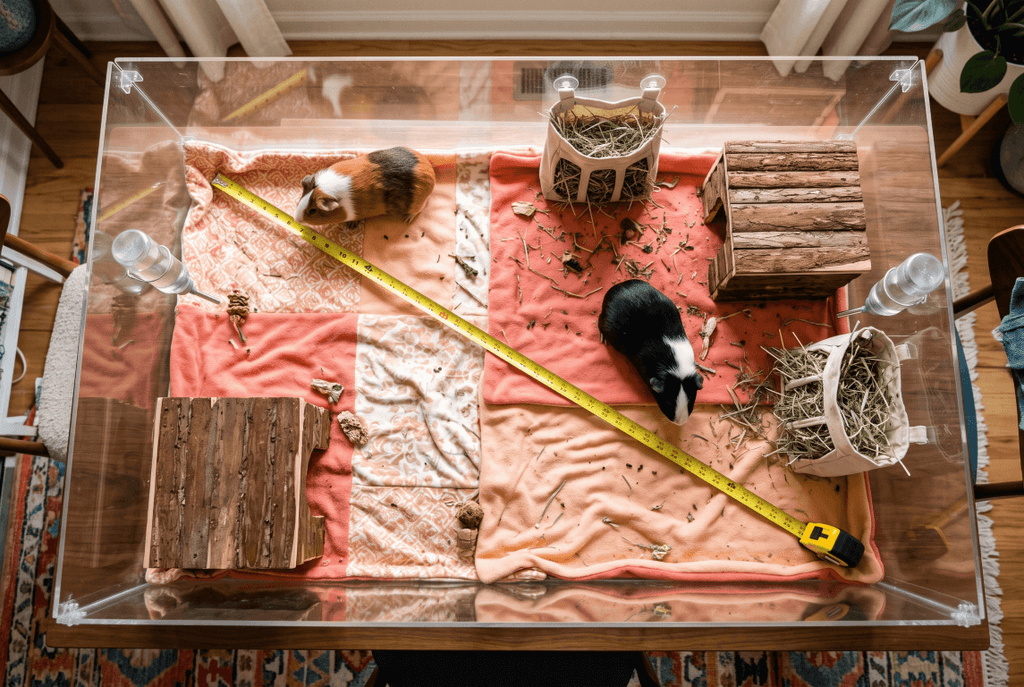
How big should a cage be for two guinea pigs?
At least 7.5 square feet of flat floor space, with 10.5 square feet (about 30 x 50 inches) or more preferred. Measure only the ground level, inside the walls. If you have two males, aim above the preferred size.
Quick reference: guinea pig cage size by number of guinea pigs
| Guinea pigs | Minimum floor space | Preferred floor space | Example size |
|---|---|---|---|
| 1 | 7.5 sq ft | Bigger is better | 30 x 36 in |
| 2 | 7.5 sq ft | 10.5 sq ft or more | 30 x 50 in |
| 3 | 10.5 sq ft | 13 sq ft or more | 30 x 62 in |
| 4 | 13 sq ft | About 16 sq ft or more | 30 x 76 in |
Figures from Humane World for Animals’ guinea pig housing guidance. Guinea pigs are social and do best with at least one companion, so the single-pig row is for reference.
Highlights
- Two guinea pigs: 7.5 sq ft minimum, 10.5 sq ft or more preferred.
- Three need at least 10.5 sq ft; four need at least 13 sq ft.
- Measure only the flat ground floor, inside the walls.
Guinea Pig Haven Tip
Save or screenshot this chart and check it before you buy any cage or panel kit. A box that says “for guinea pigs” doesn’t guarantee the floor space is big enough.
Rule 1: Floor Space Comes First
The cage size that matters is the flat floor your guinea pigs can walk on, measured on one level. Height, lofts and total cage volume don’t make up for a small footprint.
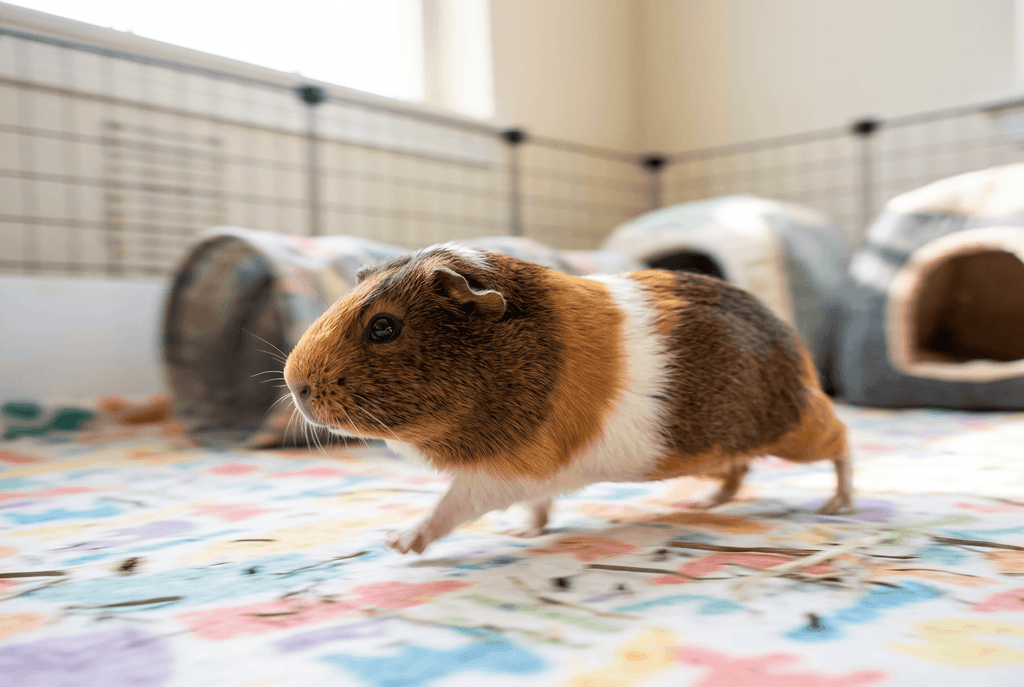
Why does floor space matter more than height?
Guinea pigs live on the ground. They exercise by running, exploring and popcorning across the floor, not by climbing, so veterinary and welfare guidance sizes their housing by floor area.
If you’ve ever watched guinea pigs do zoomies, you’ve seen why. They need room to build up speed, turn around, and get away from each other when they want space. A tall cage with a small base gives them none of that.
This is where many store-bought cages fall short. A common 30 x 18 inch cage works out to 3.75 square feet, about half the minimum for even one guinea pig. If you already have one, that isn’t a failure; plenty of new owners start there because the box says it’s for guinea pigs. The fix is knowing what to measure.
Highlights
- Measure floor space, not height or volume.
- Guinea pigs exercise horizontally: running, exploring and popcorning.
- Many cages marketed for guinea pigs are smaller than welfare minimums.
Guinea Pig Haven Tip
Measure the inside of the cage base, wall to wall. Outside dimensions on the box often include trays and lips your guinea pigs can’t use.
Rule 2: Start at 7.5 Square Feet for Two, and Aim for 10.5
Two guinea pigs need at least 7.5 square feet of floor space. Humane World for Animals prefers 10.5 square feet or more, about 30 x 50 inches.
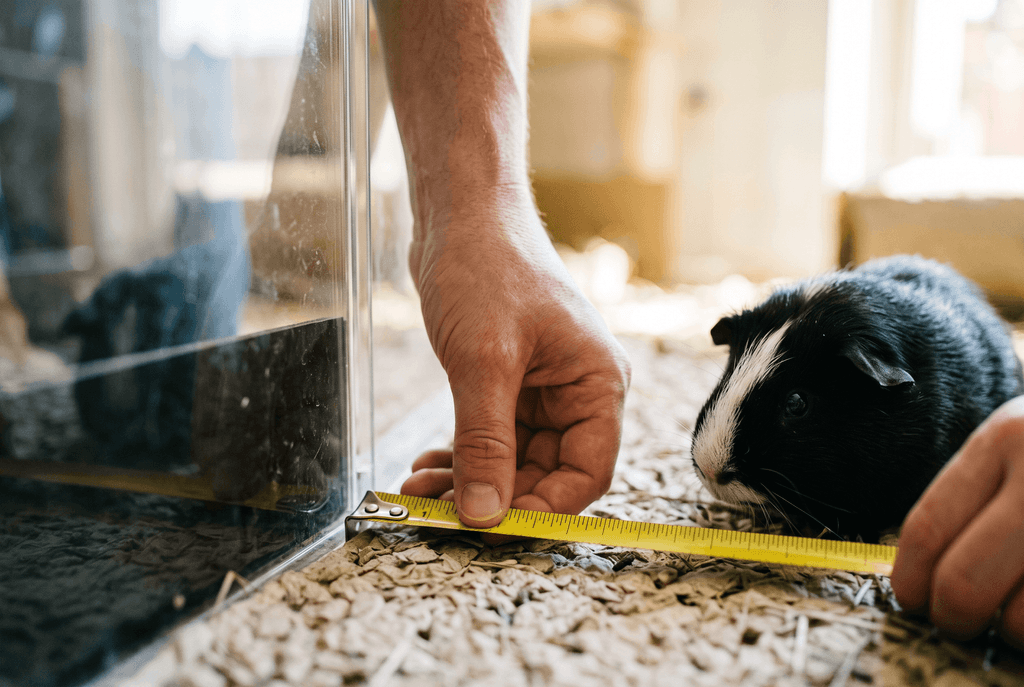
How do I calculate my cage’s square footage?
Multiply the inside length by the inside width in inches, then divide by 144. A 30 x 50 inch cage is 1,500 square inches, or about 10.4 square feet.
Think of 7.5 square feet as the floor, not the goal. It’s the smallest size welfare organizations accept for a pair, while 10.5 square feet is the size they recommend when you can manage it. The Merck Veterinary Manual lands in a similar place, recommending at least 7 square feet for one guinea pig plus 2–4 square feet for each additional animal.
The difference between minimum and preferred is real for your guinea pigs. A bigger space gives a pair room for separate hides, a hay area that isn’t crowded, and a clear lane to run.
Quick measuring examples
| Cage (inside) | Square feet | For two guinea pigs |
|---|---|---|
| 30 x 18 in | 3.75 sq ft | Too small |
| 30 x 36 in | 7.5 sq ft | Minimum |
| 24 x 48 in | 8 sq ft | Above minimum |
| 30 x 50 in | About 10.4 sq ft | Preferred |
| 30 x 62 in | About 12.9 sq ft | Roomy |
Highlights
- Minimum for two: 7.5 sq ft.
- Preferred for two: 10.5 sq ft or more.
- Formula: length x width in inches ÷ 144.
Guinea Pig Haven Tip
Write your cage’s square footage on a sticky note and keep it with your supply list. It makes comparing cages, panels or upgrades much faster.
Rule 3: Add Space for Every Extra Guinea Pig
Each additional guinea pig needs roughly 2–4 more square feet. Three guinea pigs need at least 10.5 square feet, and four need at least 13.
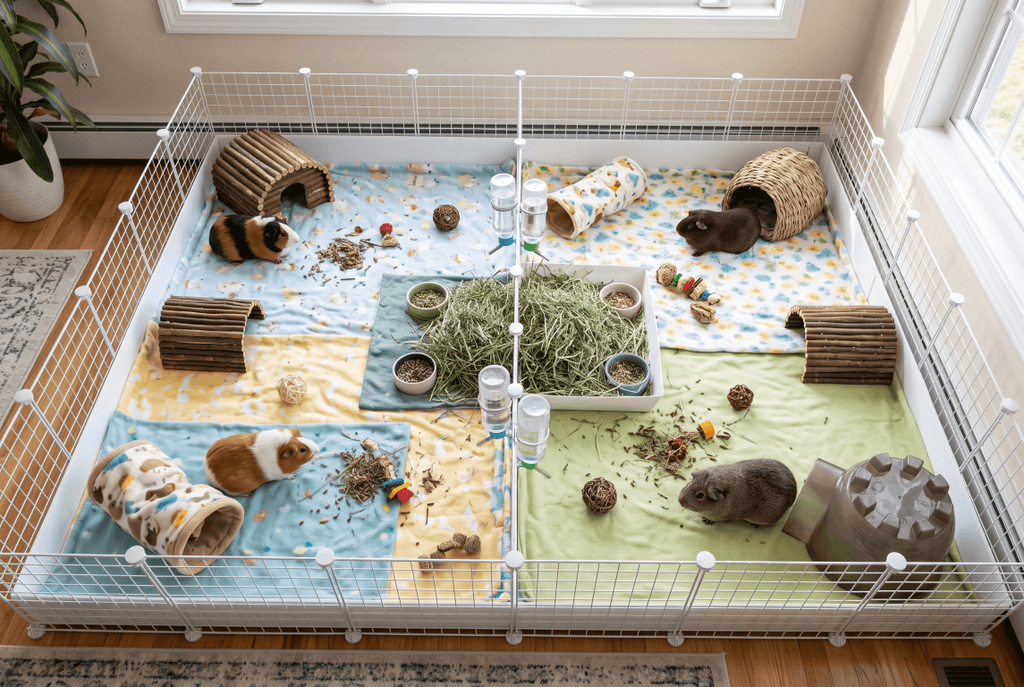
How much space does each extra guinea pig need?
The Merck Veterinary Manual recommends adding about 2–4 square feet per additional guinea pig. Humane World for Animals sets 10.5 square feet as the minimum for three and 13 square feet for four, with more preferred.
Guinea pigs are herd animals, and the RSPCA advises keeping them with at least one friendly companion unless a vet or behaviorist advises otherwise. That’s wonderful for them socially, but every new herd member needs room of their own: another hide, more space at the hay, and more floor to roam.
One note on single guinea pigs: a lone guinea pig still needs the same 7.5-square-foot minimum. Fewer guinea pigs doesn’t mean a smaller cage is fine.
Highlights
- Add about 2–4 sq ft per extra guinea pig.
- Three guinea pigs: 10.5 sq ft minimum. Four: 13 sq ft minimum.
- Even one guinea pig needs at least 7.5 sq ft.
Guinea Pig Haven Tip
If you think you might add a guinea pig later, size the cage for the herd you’ll have, not the one you have today.
Rule 4: Give Two Males Extra Room
Pairs of male guinea pigs often do best with more than the minimum. Extra floor space lets them keep their distance, especially during their teenage months.
Do two male guinea pigs need a bigger cage?
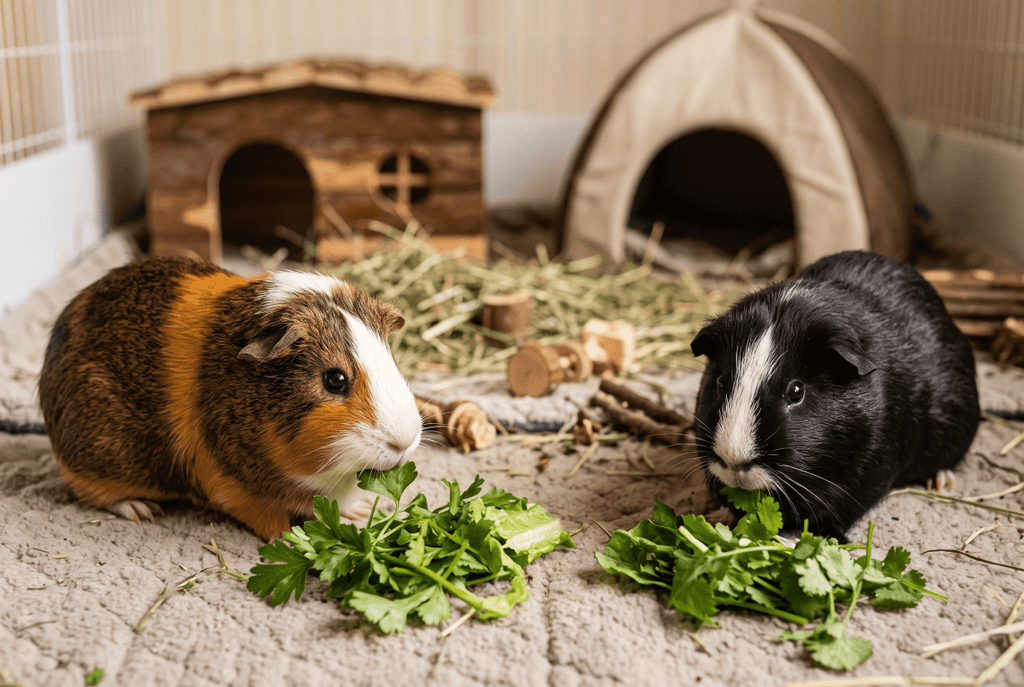
Many guinea pig rescues and experienced keepers recommend going above the preferred size for two males. Boars can be more territorial, and extra room gives each one space to retreat instead of squabbling.
Males can live together happily, and plenty of bonded boar pairs do. But as they grow up, hormones can make them more sensitive about space and resources. A roomier cage with duplicate everything takes a lot of pressure off.
Our experience: We started with a modular cage that we later learned is sized well for two females, while two males usually need more room. Pumpkin and Spice are still small and getting along great, but we’re planning to add panels and expand their floor space within the next six months rather than waiting for problems.
Highlights
- Aim above 10.5 sq ft for two males when you can.
- Give each boy his own hide, food spot and space at the hay.
- Plan for adult size and adolescence, not just how they act as babies.
Guinea Pig Haven Tip
If two boys start chasing, mounting or teeth-chattering more than usual, look at space and resources first. If either one is injured or the fighting draws blood, separate them safely and call your vet.
Rule 5: Upper Levels and Ramps Don’t Count
Lofts and second stories can add interest, but they don’t add floor space. The ground level should meet the size guidelines on its own.
Does a second level count toward guinea pig cage size?
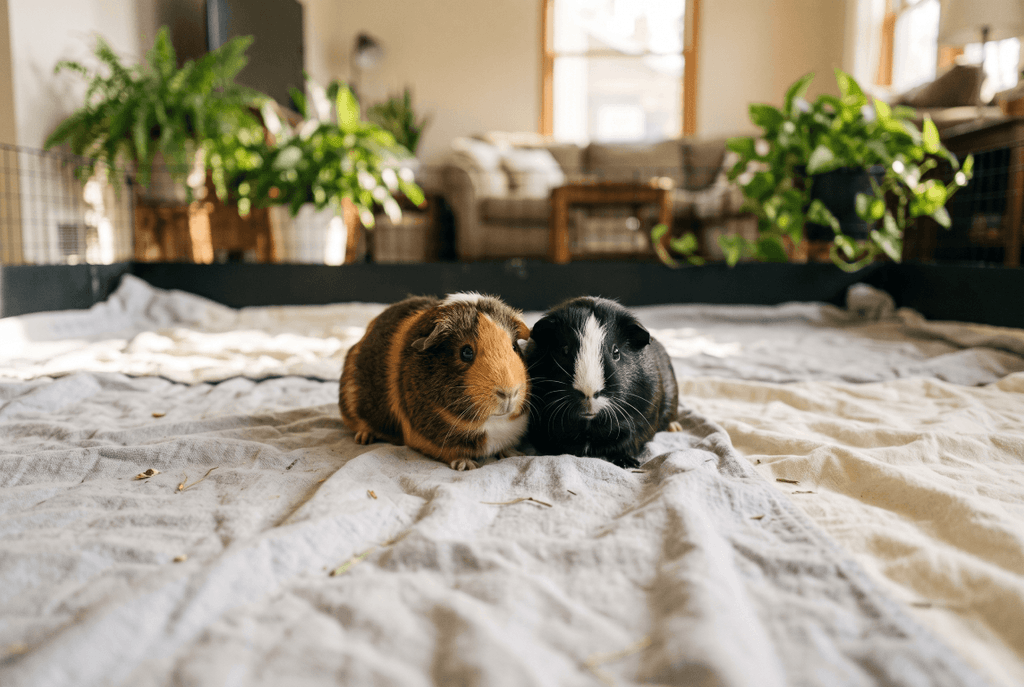
No. Guinea pigs need their space on one level, and a ramp’s base can actually take floor space away. Count only the flat ground floor when you measure.
Guinea pigs aren’t natural climbers. Many won’t use steep ramps at all, and a fall from a raised level can injure them, particularly as they get older and less steady. That doesn’t make every platform dangerous, but it does mean a loft is a bonus, never a substitute for floor space.
Our experience: We were about to buy a second level for the boys. Then we learned that floor space is what guinea pigs actually use and that climbing isn’t great for their backs, so we dropped the plan. Spreading out, not up, is our approach now.
If you do add a platform, keep it low, give the ramp a gentle slope with solid sides, and use a solid, grippy surface rather than wire.
Highlights
- Measure only the ground floor.
- Ramp bases take up floor space.
- Keep any platform low, gentle and enclosed.
Guinea Pig Haven Tip
Watch where your guinea pigs actually spend time for a few days. Most owners find their pigs live almost entirely on the ground floor.
Rule 6: Make It Tall Enough to Stand and Popcorn
Your cage should let guinea pigs stand fully on their back legs and popcorn freely. The Merck Veterinary Manual suggests a cage height of about 18 inches.
How tall should a guinea pig cage be?
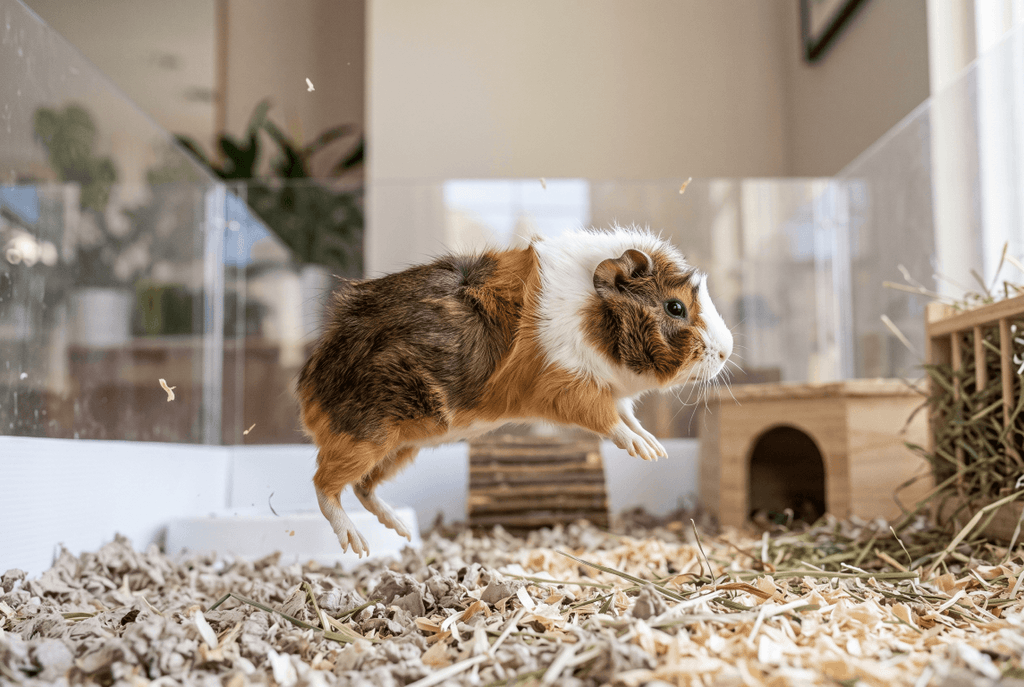
Tall enough for your guinea pigs to stand upright on their back legs. The RSPCA notes young guinea pigs need around 30 cm (about 12 inches) of height to popcorn, and Merck suggests a cage height of about 18 inches.
Height matters less than floor space, but it still matters. Guinea pigs stretch up to sniff, look around and reach hay. Young guinea pigs especially love to popcorn, those sudden happy jumps, and need clearance to do it safely.
Guinea pigs usually don’t jump out of their cage, so a lid isn’t always necessary. If you have cats, dogs or curious small children, a cover adds protection.
Our experience: We use the mesh lid that came with our cage. Our cat stays mostly outside and ignores the boys, and the dogs lost interest after one sniff. Cats are still predators, though, so we always supervise, and a solid cover is worth considering if your cat might climb or nap on top.
Highlights
- Room to stand fully upright and popcorn.
- About 18 inches of height is a good target.
- Add a lid if other pets or small children are around.
Guinea Pig Haven Tip
Clear panels let you watch your guinea pigs without fingers poking through. We chose them partly so our toddler could see the boys safely.
Rule 7: Choose a Solid Floor, Never Wire
Guinea pig cages need a solid floor. Wire or grid floors can hurt their feet and lead to sore, inflamed foot pads.
Why are wire-bottom cages bad for guinea pigs?
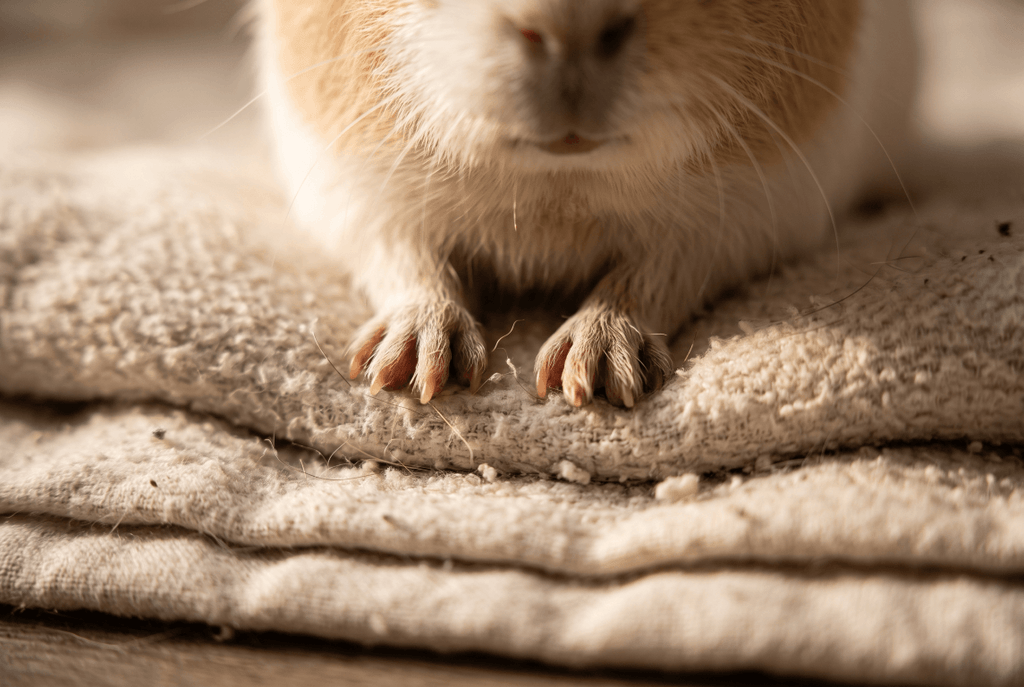
Guinea pigs have delicate feet. The Merck Veterinary Manual says a solid floor is essential to avoid foot sores (pododermatitis) and foot or leg injuries, and the RSPCA warns against grid floors for the same reason.
A solid base also holds bedding properly, which keeps your guinea pigs cushioned, dry and comfortable. The floor and everything on it should be chew-safe, because guinea pigs will test anything they can reach with their teeth.
Our experience: Chew safety is the lesson we learned the hard way. We tried dog pee pads once, and the boys went straight for the plastic edges. That was our biggest scare so far. Now we ask one question about anything that goes on the cage floor: what happens if they chew it?
Highlights
- Solid floor only; no wire or grid bottoms.
- Wire floors can cause foot sores and injuries.
- Everything on the floor should be safe to chew.
Guinea Pig Haven Tip
If you inherit a cage with a wire floor, cover it completely with a solid, chew-safe surface, and check your guinea pigs’ feet regularly for redness or swelling.
Rule 8: Leave Room After the Furniture Goes In
Hides, hay, bowls and water bottles all take up floor space. Size your cage so there’s still an open lane to run after everything is in place.
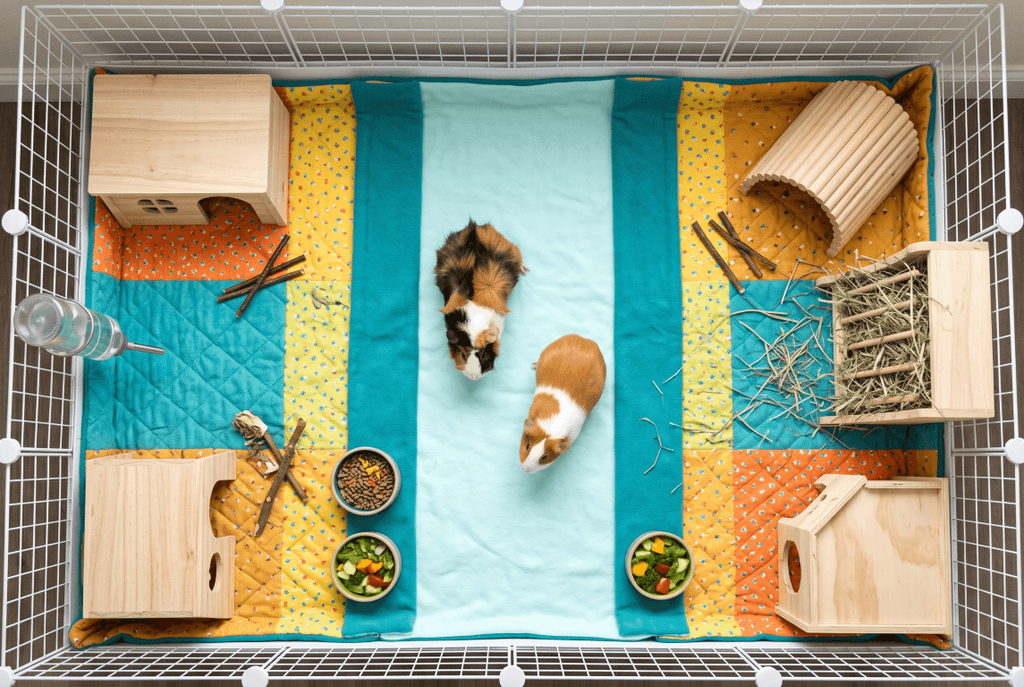
How many hides do guinea pigs need?
More hides than guinea pigs. The Merck Veterinary Manual says there should be more hiding spots than guinea pigs, and the RSPCA recommends refuges that outnumber the animals by one, so two guinea pigs need at least three.
This is the rule that quietly shrinks a cage. A setup that measures 8 square feet empty can feel cramped once you add three hides, a hay station and food bowls. Guinea pigs feel safer with shelter nearby, so hides aren’t optional, which is exactly why the cage needs room for them plus open floor.
Our experience: We started with one wooden hide and learned afterward that each guinea pig should have their own, plus a spare. The boys share happily while they’re small, and we drape a blanket over about a third of the cage as a full hideaway. Our surprise discovery: they love hiding in their hay bags. More hides are coming with our expansion.
Highlights
- Two guinea pigs: at least three hides.
- Furniture reduces open floor space.
- Keep a clear running lane after setup.
Guinea Pig Haven Tip
Sketch your layout on paper before buying a cage. Draw in each hide, the hay area and bowls, and see what open space is left.
Rule 9: Plan Daily Time Outside the Cage
Even a properly sized cage isn’t the whole picture. Guinea pigs benefit from daily exercise time in a safe, guinea-pig-proofed area.
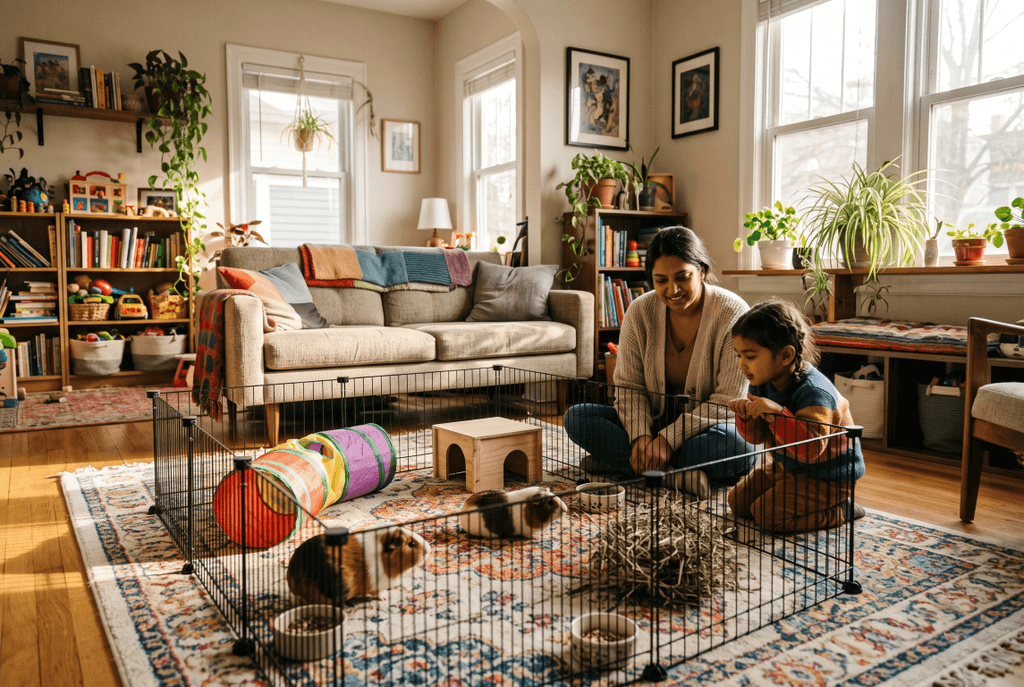
Do guinea pigs need time out of their cage?
Yes. The RSPCA recommends access to a larger exercise area, and the Merck Veterinary Manual advises daily supervised out-of-cage time in a space with no cords or chew hazards.
Floor time is a bonus on top of a good cage, not a replacement for one. Your guinea pigs spend most of their lives in their enclosure, so it needs to meet the size guidelines on its own.
Skip exercise wheels and balls. Merck warns that wheels can injure guinea pigs, and their bodies aren’t built for them.
Highlights
- Daily supervised floor time in a safe area.
- Remove cords and anything chewable.
- No wheels or exercise balls.
Guinea Pig Haven Tip
Add a couple of tunnels and a hide to the floor-time area. Guinea pigs explore more confidently when they have cover nearby.
Rule 10: Plan Where It Goes and How It Will Grow
The right cage size also depends on where it sits. Choose a calm, draft-free spot with steady temperatures, and leave room to expand.
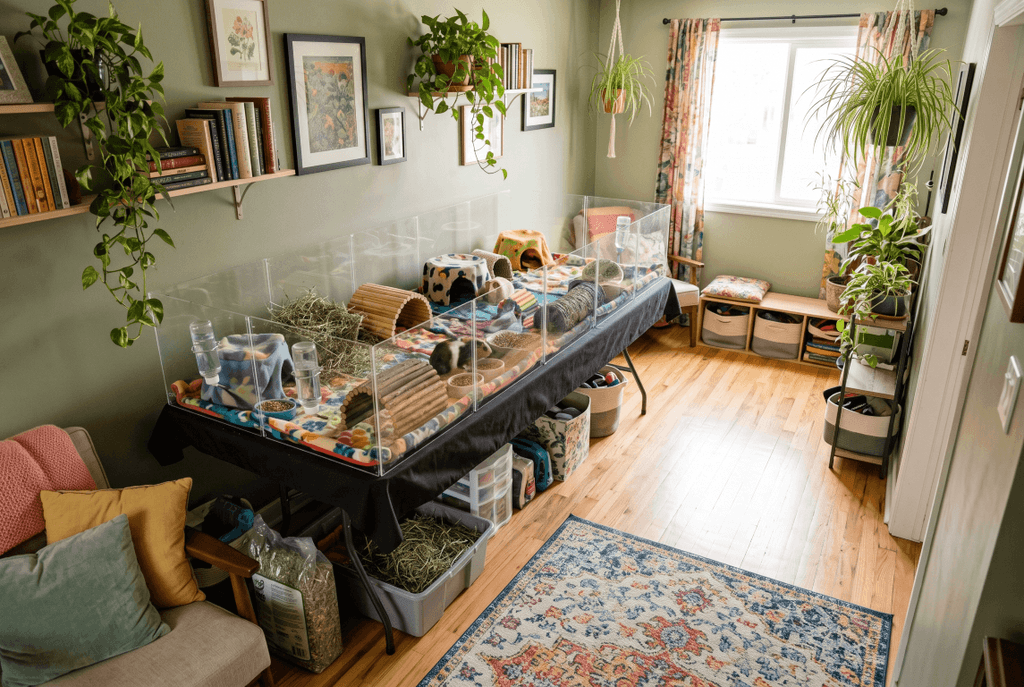
Where should I put a guinea pig cage?
In a calm room with steady temperatures, away from drafts, heaters and sunny windows. The RSPCA suggests 17–20°C (about 63–68°F) as ideal and warns that temperatures above 26°C (about 79°F) risk heatstroke.
Humane World for Animals also recommends avoiding garages and other unheated spaces, keeping the cage out of the kitchen, and placing it where other pets can’t bother your guinea pigs. If you have young children, put it somewhere you can supervise.
Then think ahead. Many guinea pig rescues recommend modular grid-and-panel cages, often called C&C cages, partly because you can extend them later instead of replacing them.
Our experience: We didn’t want the boys on the floor, so the cage went on a table. The first table was too short, so the cage sat on the floor for a while. The second was exactly the cage’s size, with no room for anything else. Now we use a longer folding table, and when we expand, the table has to grow too. Our advice: plan your table and cage together.
Highlights
- Steady temperatures, no drafts or direct sun.
- Away from other pets, the kitchen and garages.
- Choose a setup, and a table, that can grow.
Guinea Pig Haven Tip
Measure the space where the cage will live before you shop, including room for future panels. It’s easier to buy the right size once than to rearrange a room later.
What We Learned Sizing a Cage for Our Two Boys
Our biggest cage-size lesson was that a setup can be a good start and still not be the long-term answer, especially for two males.
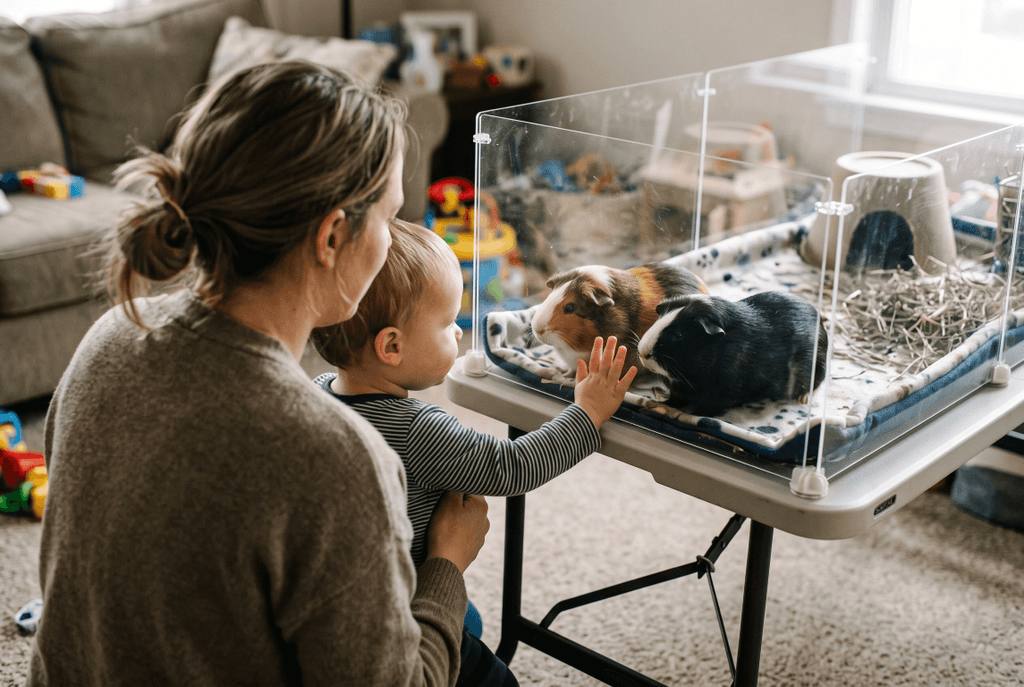
What would we do differently?
We’d measure square footage before buying, size for two adult males from day one, and pick a table with room to grow. Everything else on this list we’d keep.
This is our firsthand experience, separate from the research above:
- We skipped the pet-store cages. The ones we found cost more and were smaller than welfare guidance recommends, so we chose a modular clear-panel cage instead.
- We learned our size suits two females better than two males. The boys are thriving while small, and we’re planning to expand their floor space within about six months.
- We dropped the second-level plan once we learned floor space is what matters.
- We started with one hide and now know each guinea pig needs their own, plus a spare.
- We went through three tables before finding one long enough, and it will need to grow with the cage.
We’ll keep documenting the expansion, including whether a bigger setup makes cleaning easier or harder, in Our Guinea Pig Journey.
Highlights
- Measure square footage before you buy.
- Size for two adult males from the start.
- Plan the table and the cage together.
Guinea Pig Haven Tip
Take a photo of your setup every time you change it. It’s an easy way to see what’s working and remember why you made each change.
How Welfare and Vet Guidelines Compare
Guinea pig cage size guidelines vary a little between organizations, but most set the minimum for a pair at around 7–8 square feet and recommend 10.5 square feet or more.
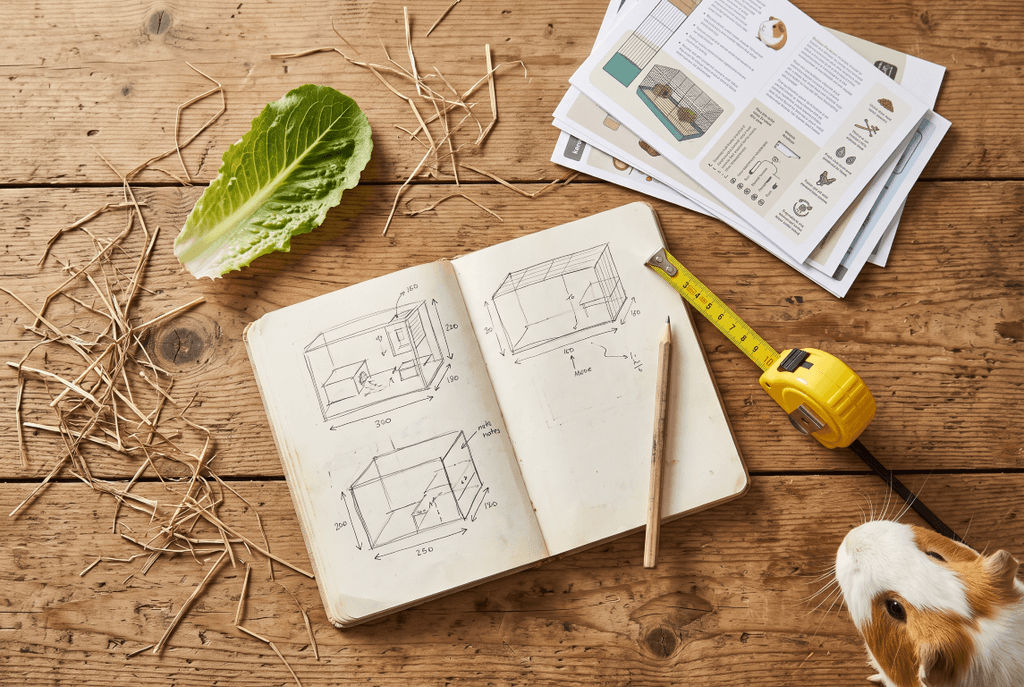
Why do guinea pig cage size recommendations differ?
Each organization writes for its own audience and country, and some publish adoption requirements while others publish care minimums. The numbers differ slightly, but every source agrees that more floor space on one solid level is better.
Here’s how the major guidelines compare side by side.
| Source | Two guinea pigs | Each extra guinea pig | Notes |
|---|---|---|---|
| Humane World for Animals (US) | 7.5 sq ft minimum, 10.5 sq ft preferred | Three: 10.5 sq ft minimum; four: 13 sq ft minimum | Calls 7.5 sq ft the bare minimum even for one guinea pig |
| Merck Veterinary Manual | At least 7 sq ft for one, plus 2–4 sq ft for the second | Add 2–4 sq ft | Suggests about 18 inches of height and a solid floor |
| RSPCA (UK), as cited by UK vet practices | 120 x 60 cm (about 4 x 2 ft, roughly 7.75 sq ft) | Not specified | Also stresses standing height, solid floors and an exercise area |
| Dakin Humane Society (adoption requirement) | 6.5 sq ft minimum, 10.5 sq ft preferred | Three: 8 sq ft minimum, 13 sq ft preferred | Notes most pet-store housing is too small |
Highlights
- Most minimums for a pair sit around 7–8 sq ft.
- 10.5 sq ft or more is the most common preferred target.
- Every source favors one solid, spacious level.
Guinea Pig Haven Tip
When guidelines differ, follow the larger number. Our rule of thumb: never go under 7.5 square feet for a pair, aim for 10.5 or more, and add extra room for two males.
When Housing Problems Need a Vet
A cage that’s too small or poorly set up can contribute to foot sores, injuries and fighting. Any of these signs needs a vet, not a home fix.
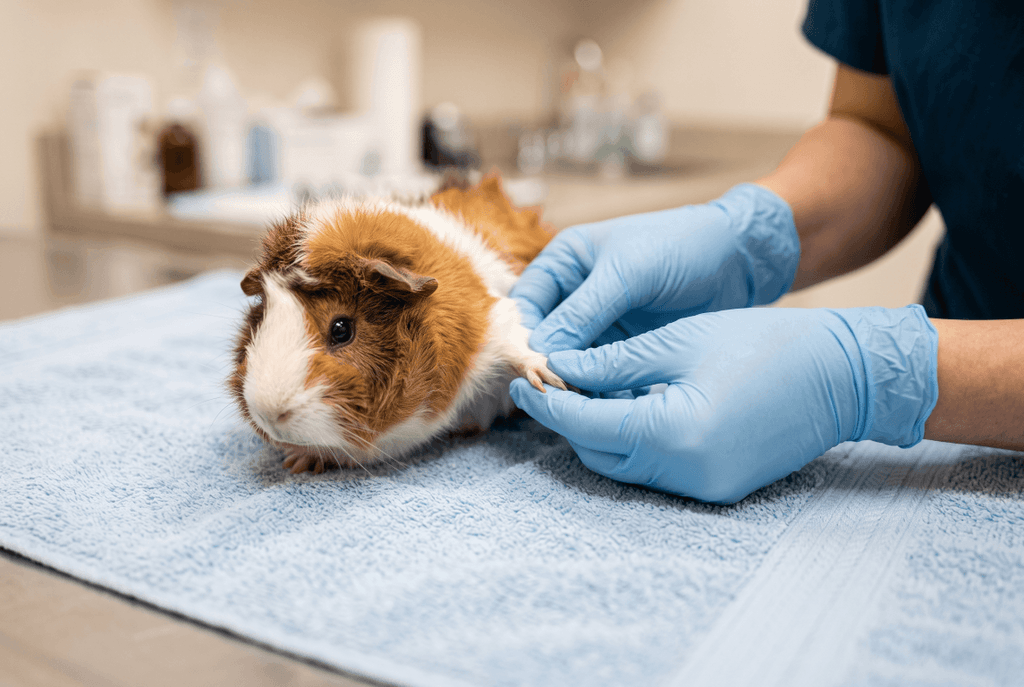
Call promptly if you see sore or swollen feet, limping, bite wounds, or a guinea pig that stops eating. These signs can have several causes, so a guinea-pig-savvy vet should examine your pet.
Cage size and setup affect health, but they can’t replace veterinary care. Contact an exotic-pet or guinea-pig-savvy vet promptly if you notice:
- Red, swollen, scabbed or sore-looking feet
- Limping or reluctance to move, especially after a fall from a ramp or platform
- Bite wounds, or fighting that draws blood
- A guinea pig that stops eating, hides constantly or sits hunched
Highlights
- Check feet during regular handling.
- Separate fighting guinea pigs safely and call your vet.
- Don’t treat injuries at home.
Guinea Pig Haven Tip
Find an exotic-pet vet before you need one, and save their number now so you’re not searching during an emergency.
Guinea Pig Cage Size FAQs: Your Space Questions Answered
Still unsure whether your guinea pig cage size is right? These are the questions new owners ask most when they’re measuring, shopping or planning an upgrade.
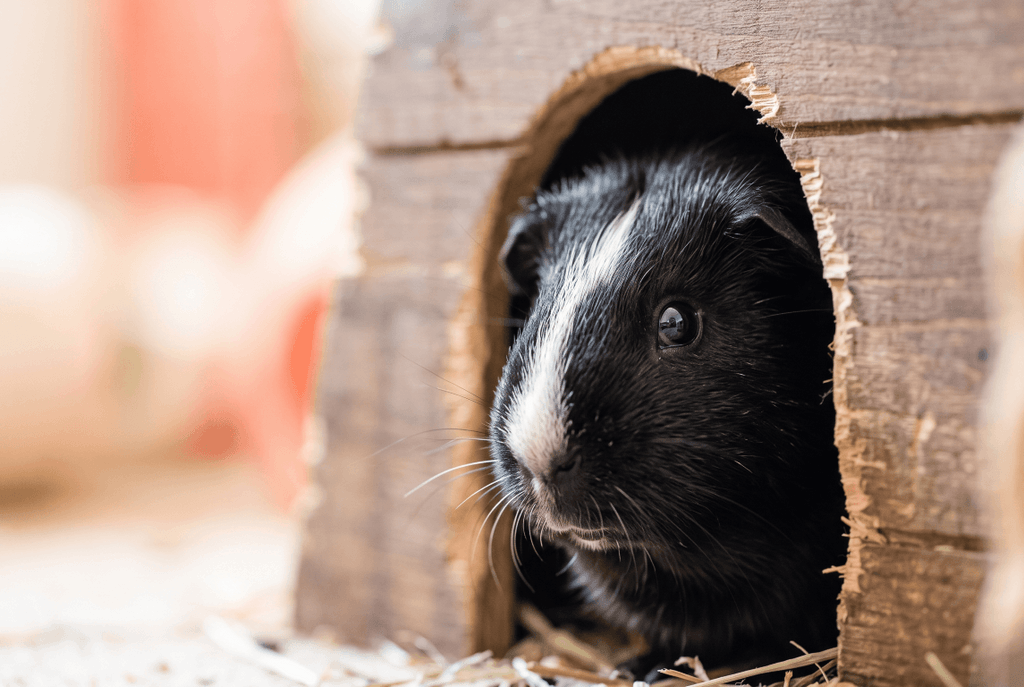
Is a 30 x 50 inch cage big enough for two guinea pigs?
Yes. A 30 x 50 inch cage gives about 10.4 square feet of floor space, which matches the preferred size for a pair. For two males, going a little bigger is even better.
Is a 2 x 4 foot cage big enough for two guinea pigs?
A 2 x 4 foot cage gives 8 square feet, which is above the 7.5-square-foot minimum but below the 10.5-square-foot preferred size. It works for a pair, but bigger is better if you can manage it.
Can one guinea pig live in a smaller cage?
No. Humane World for Animals treats 7.5 square feet as the bare minimum even for a single guinea pig. Guinea pigs are also social animals and usually do best with at least one companion.
Do hides and food bowls count toward floor space?
They sit inside the floor area, but they reduce the open space your guinea pigs can actually move around in. That’s why it helps to size up beyond the minimum once you add the hides, hay and bowls they need.
Can baby guinea pigs start in a smaller cage?
Young guinea pigs grow quickly and are especially playful, so they need room to run and popcorn too. It’s easier to start with a cage sized for adults than to replace one a few months later.
How do I measure guinea pig cage size?
Measure the inside length and width of the ground floor in inches, multiply them, and divide by 144 to get square feet. Don’t count upper levels or ramps.
Give Them Room to Be Guinea Pigs
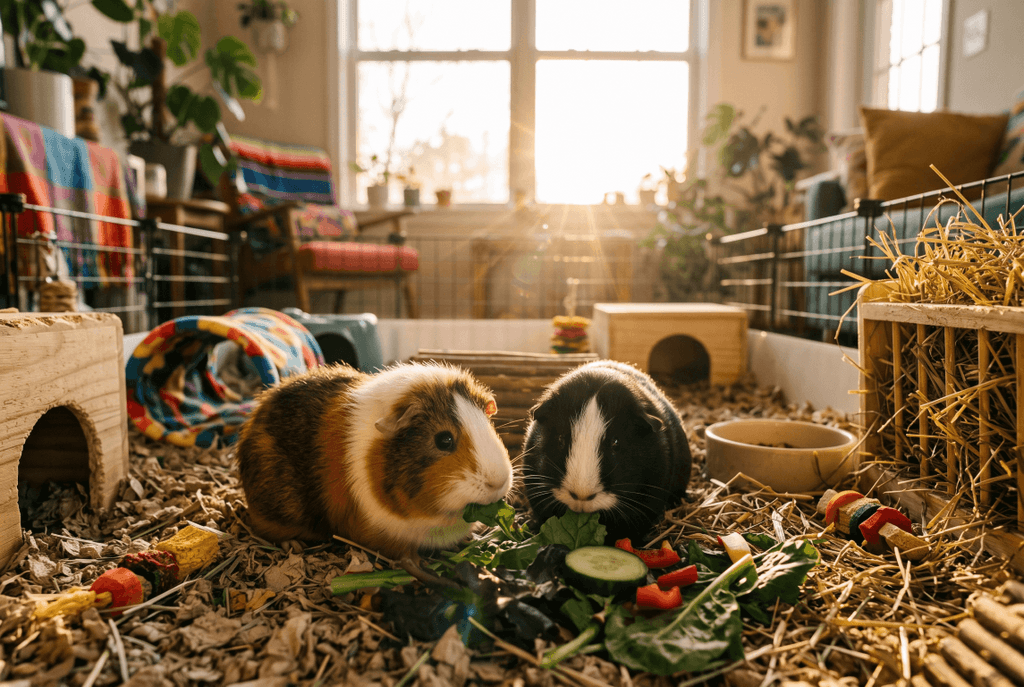
The right cage size is simple once you know what to measure: flat, solid floor space on one level, at least 7.5 square feet for two and 10.5 or more whenever you can. Add room for every extra guinea pig, give boys a little more, and leave space after the hides go in.
Ready to put it all together? Follow our step-by-step guide Guinea Pig Cage Setup: 7 Essential Steps That Work, and see what we’d change in First Guinea Pig Cage: 10 Costly Mistakes We Fixed. New to guinea pigs? Start with The Complete Guinea Pig Care Guide for Beginners.